
News
Boeing predicts need for 3,300 new planes by 2044 for Indian and South Asian airlines
January 29th 2026
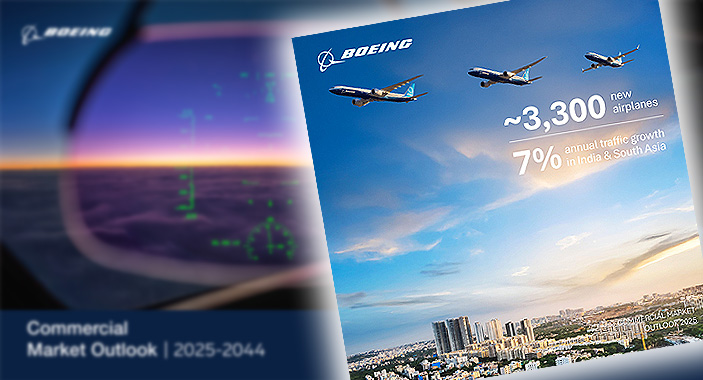
India and South Asia’s passenger air traffic will rise an average of 7% annually over the next 20 years, spurred by a growing middle class, economic growth, and airport and connectivity investments, Boeing said in its latest Commercial Market Outlook (CMO) for South Asia. Read More » This growth will create the demand for 3,300 new airplanes by 2044. Single-aisle jets will account for nearly 90% of the projected deliveries. Accounting for growth and replacement, the Indian and South Asian region’s fleet will grow from 795 to 2,925 airplanes in two decades ─ a nearly four-fold increase over that time. Domestic travel that connects India will underpin this expansion, supported by a continuing shift from rail to air and investments in the country’s airport infrastructure. Indian and South Asian airlines are also projected to expand and diversify their long-haul networks as India grows as a key hub for international passenger and cargo traffic. The South Asia region’s widebody fleet will more than triple by 2044 as carriers enable millions of Indian and South Asian passengers to travel to international markets, including the Middle East, Europe, and North America, the OEM predicts. “As air travel becomes more integral to how people and goods move in India and South Asia, airlines will strengthen networks, scale fleets, and invest in services and technical personnel to support long-term growth. More efficient, versatile airplanes will enable robust growth opportunities for the region’s established and emerging airlines,” said Ashwin Naidu, Boeing managing director of Commercial Marketing, Eurasia and Indian Subcontinent. To support the expected fleet growth, investment in the South Asia region’s industry will require more than $195 billion in aviation services, including maintenance, repair and modifications, digital services, and training. Boeing projects the Indian and South Asian aviation industry will also need approximately 141,000 new professionals, including about 45,000 pilots, 45,000 technicians, and 51,000 cabin crew, over the next two decades.

