
News
Regional airlines association data for January shows continued growth in international air passenger and air cargo markets
February 27th 2026
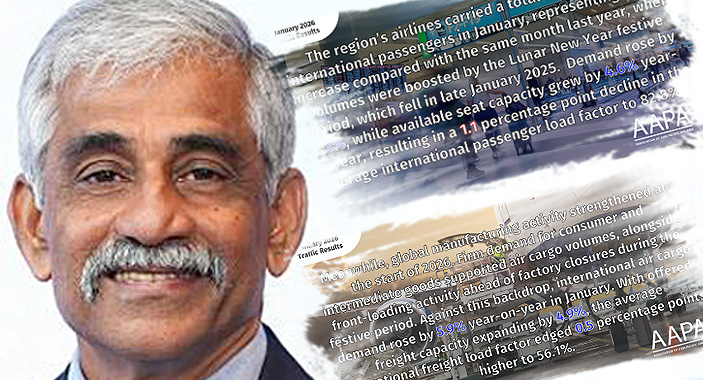
Preliminary January 2026 traffic figures released today by the Association of Asia Pacific Airlines (AAPA) showed continued growth in both international air passenger and air cargo markets, supported by the steady expansion in global economic activity, the association said. Read More » The region’s airlines carried a total of 35.5 million international passengers in January, representing a 3.6% increase compared with the same month last year, when volumes were boosted by the Lunar New Year festive period, which fell in late January 2025. Demand (RPK) on international routes rose by 3.3%. In comparison, available seat capacity (ASK) grew by 4.6% year-on-year, resulting in a 1.1 percentage point decline in the average international passenger load factor to 82.8%. AAPA reported that global manufacturing activity strengthened at the start of 2026. Firm demand for consumer and intermediate goods supported air cargo volumes, alongside front-loading activity ahead of factory closures during the festive period. International air cargo demand (FTK) rose by 5.9% year-on-year in January. With offered freight capacity (FATK) expanding by 4.9%, the average international freight load factor edged 0.5 percentage points higher to 56.1%. “The year began on a positive footing for Asian carriers, with international passenger and cargo markets maintaining growth momentum into 2026, building on gains achieved last year. Expanded network connectivity has provided travellers with greater choice during the festive period, while the strengthening of selected Asian currencies has also supported outbound travel. Continued global demand for goods produced in Asia, partly reflecting shifts in global supply chains, has likewise supported air cargo activity,” Subhas Menon, AAPA Director General, said. “The overall picture for the year ahead looks broadly positive, with underlying global economic conditions relatively firm. Nevertheless, geopolitical and trade developments continue to pose uncertainty. At the same time, airlines face intensifying competition and persistently high costs, and are carefully managing expenses to preserve profitability,” he added.

