
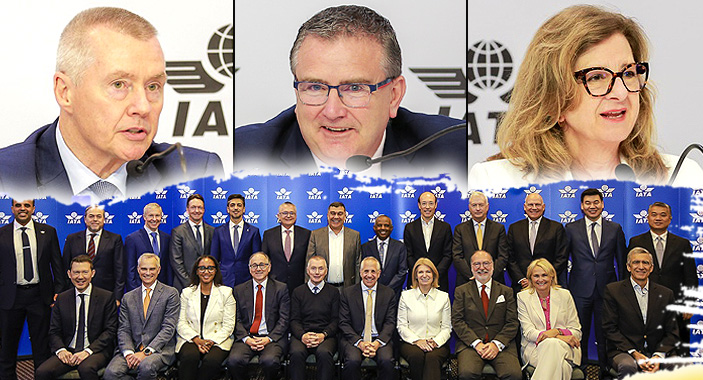
82nd IATA AGM and WATS: News Coverage
Sustainable Aviation Fuel levels disappointing, Asia has high potential to become major producer
June 9th 2026
The International Air Transport Association (IATA) released estimates showing that global Sustainable Aviation Fuel (SAF) production is expected to reach around 2.4 million tonnes in 2026, representing just 0.8% of aviation fuel use, at a cost to airlines of $4.3 billion. Read More »
The association highlighted that, although the airline industry and producers are making efforts to ramp up SAF production, there is a lack of support and, in some cases, undermining of the CORSIA agreement by governments and politicians. “It looks to be another disappointing year for SAF production. Five years after committing to achieve net-zero by 2050, SAF production will account for only 0.8% of airline fuel use this year. The path to meeting 65% of our needs in 2050 is growing more difficult with each year of ineffectively sequenced government policies and oil companies’ manifest lack of interest. The current energy shock should add even more urgency to the development of renewables, including SAF. But we have yet to see either the energy shock, the need to develop energy independence and jobs, or the urgency to mitigate climate change materialize in the incentives needed to create a viable SAF market,” said Willie Walsh, IATA’s Director General.
At the same time, meaningful progress can be seen in North Asia and the Asia-Pacific region. In China, currently there are around 10 producers operating SAF facilities, with over 2 Mt of SAF capacity expected by the end of 2026. Industry policy to support SAF is under discussion for inclusion in the nation’s 15th Five-Year Plan. In 2025, the country completed the SAF pilot usage program.
Asia-Pacific’s current SAF production capacity is 7 Mt, with production projected to reach 55 Mt by 2030. There are 28 ongoing SAF projects.
Engine supply chain issues draw ire during the airline industry’s annual gathering
Global aircraft backlog reached 18,102, more than half of the number of aircraft currently in operation, the International Air Transport Association (IATA) said. “The aircraft order backlog is over 18,000. And the average fleet age has reached a record 15.2 years. Moreover, being short by over 5,000 more fuel-efficient replacement aircraft that we had counted on means missed efficiency gains, not to mention higher lease rates and increased maintenance costs. In total, supply chain failures cost airlines at least $11 billion in 2025. Today’s higher fuel prices will only make that worse,” the IATA director general Willie Walsh told delegates in his opening address at the Annual General Meeting (AGM) & World Air Transport Summit (WATS) in Rio de Janeiro, Brazil, hosted by LATAM Airlines Group. “Deeply disappointed customers have not dented manufacturer finances. For example, most engine manufacturers’ profits were up double digits. I cannot share my reaction to this paradox in polite company, so I leave you to draw your own conclusions. But then again, when have you guys ever been polite? So, let me tell you what I think. My message to the engine OEMs is simple – stop gouging us and get back to making great engines that work and that last. Allowing these failures to extend into the next decade is totally unacceptable to the customers,” he said, drawing applause from the delegates present in the room. During the following press briefing, Walsh told the media that the airframe OEM had recently made progress in production rates. He also clarified that while he is not against engine OEMs making a profit, he finds it unacceptable that, at the same time, they fail to deliver reliable products.
Supply chain issues put pressure on operational safety, Nick Careen, IATA Senior Vice President, Operations, Safety and Security, said during the Safety and Operations Media Briefing. Because of the issues, 15% of the global fleet is currently in storage, including 75% of the young fleet, linked to WP1000G engine problems. Utilization rate hit an all-time high in the second half of 2025. The average aircraft age exceeded 15 years in 2025, the highest level in aviation history.
Careen added that the already constrained inventory of aircraft, engines, and spare parts is feeling additional pressure from the demand from the defense sector. The ongoing conflicts and arms buildup often force the airline industry to compete for the same parts as the military.
IATA launched important tool to support CORSIA with Asian carriers’ participation
The International Air Transport Association (IATA) launched the Supporting Alliance for CORSIA EEU Supply. The initiative is grouping stakeholders across the CORSIA ecosystem in efforts to boost the availability of 225-250 million CORSIA Eligible Emissions Units (EEUs) by spring 2027. “CORSIA is the only globally agreed framework to address international aviation emissions, established by ICAO and its Member States in 2016. States, however, have their own obligations under the Paris Agreement and the UNFCCC. Credits must be transferred between these systems to avoid double-counting, which has become an important bottleneck. The Supporting Alliance will provide implementation assistance to clear this and other bottlenecks that prevent credits from coming to the CORSIA market,” said Marie Owens Thomsen, IATA’s Senior Vice President Sustainability and Chief Economist. “It should be noted that CORSIA will likely generate $4-5 billion of climate finance in the first phase, and potentially $100 billion by 2035, depending on market prices. This will help fund climate action, support remote communities, and spur economic development. We welcome all carbon market stakeholders and related organizations to join forces in the Supporting Alliance to help CORSIA realize its potential social, economic, and climate benefits,” she added.
The initial Alliance membership encompasses over 32 entities, including strong representation of the airlines from the Asia-Pacific region, including Air Asia, All Nippon Airways (ANA), China Airlines, Japan Airlines, Scoot, and Singapore Airlines.
IATA Launches “Save a Life, Not a Bag” Passenger Safety Campaign
During the 82nd International Air Transport Association (IATA) Annual General Meeting (AGM) & World Air Transport Summit (WATS) in Rio de Janeiro, Brazil, hosted by LATAM Airlines Group, IATA announced the launch of “Save a Life, Not a Bag” passenger safety campaign urging travelers not to take cabin baggage during an aircraft evacuation. “Taking bags during an evacuation is not a minor issue. Every second matters. Even taking one bag can affect the safe evacuation of everyone on board. Crew instructions are clear and simple: leave everything behind and move quickly. “Save a Life, Not a Bag” is a message that passengers need to understand and act upon,” said Willie Walsh, IATA’s Director General. The campaign responds to the growing number of cases where travelers have stopped to collect their baggage or take photos during aircraft evacuations. Evidence of this is seen in many videos posted online.
Global airlines association successfully concluded its 82nd Annual General Meeting held in Brazil
On June 8, 2026, the International Air Transport Association’s 82nd Annual General Meeting (AGM) & World Air Transport Summit (WATS) in Rio de Janeiro, Brazil, hosted by LATAM Airlines Group, came to an end.
The event saw wide participation by delegates from the Asia-Pacific region, who, despite the long distance, traveled to Latin America to be meaningfully involved in the industry’s important event.
This year’s AGM was the last one under Willie Walsh’s tenure as the IATA’s current Director General. “In a few weeks, I will leave IATA and become the CEO of one of its members—IndiGo Airlines. In the meantime, the board is finding someone to build an even better IATA and strengthen our association. That leaves me to thank all who supported my tenure—particularly you, our members, the Board, the Board Chairs with whom I have worked closely, and especially the passionate friends and colleagues who make up the IATA team,” he said in his opening address. Throughout his term, Walsh navigated the association during the COVID-19 pandemic and in its aftermath. Asked during the media briefing whether he felt he had achieved his goals, Walsh explained that the airline industry is constantly facing new challenges, making it impossible to find permanent closure, and offered the advice that if any airline CEO claimed he had achieved all his goals, he should be fired immediately. He added that one thing he learned during his time as the IATA head was how important the association is to the whole industry and how much its voice matters. He also offered his successor all the support.
As it was announced the previous day, the 83rd IATA Annual General Meeting (AGM) and World Air Transport Summit (WATS) will be held in Xiamen, China, from 30 May to 1 June 2027, hosted by Xiamen Airlines.

